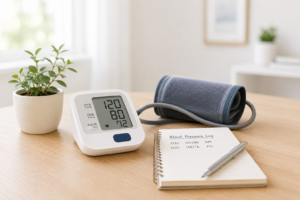
 If you’ve ever measured your blood pressure at home, you’ve probably experienced something like this.
You measure your blood pressure before breakfast. It’s 146/84 mm Hg.
One minute later, you measure it again. Now it’s 137/79 mm Hg.
Did your blood pressure really drop 9 mm Hg in one minute?
The answer is probably yes.
Blood pressure isn’t a fixed number. It changes continuously throughout the day in response to your body’s needs, your activities, and even your emotions.
Blood pressure measurement is not just about getting a number. It’s about obtaining a measurement that accurately reflects your usual blood pressure.
Understanding why blood pressure changes helps explain why healthcare professionals recommend measuring it the same way each time and why they focus on averages rather than individual readings. Before getting started, learn the recommended technique in our companion article:
How to Measure Blood Pressure Correctly at Home
Blood Pressure Is Always Changing
Your heart and blood vessels constantly adjust to meet your body’s changing needs. Walking across the room, climbing stairs, having a conversation, feeling stressed, or becoming anxious can all temporarily increase your blood pressure. As your body relaxes, your blood pressure gradually returns toward its usual resting level.
Even when you are sitting quietly, your blood pressure naturally fluctuates from minute to minute. Small differences between consecutive readings are expected and usually are not a cause for concern. Because blood pressure is dynamic, the goal is not to eliminate this normal variation.
The goal is to measure it consistently so the results accurately reflect your usual blood pressure and can be compared fairly over time.
Many Everyday Factors Can Affect Blood Pressure
Many common activities can temporarily change your blood pressure, even if you feel perfectly well.
| Factor | Typical Effect on Blood Pressure |
|---|---|
| Stress or anxiety | ↑ 10–40 mmHg |
| Caffeine | ↑ 3–15 mmHg |
| Physical activity | Temporary increase during exercise |
| Full bladder | ↑ up to 10–15 mmHg |
| Eating a meal | Temporary decrease in some people |
| Blood pressure medication | Temporary decrease depending on medication |
| Poor posture | Can increase or decrease readings |
| Talking during measurement | ↑ 5–15 mmHg |
These changes are normal. Measuring your blood pressure under the same resting conditions every time helps ensure your readings reflect your usual blood pressure rather than temporary influences.
Why Consistent Blood Pressure Measurement Matters
Blood pressure treatment recommendations are based on decades of clinical research involving hundreds of thousands of patients. These studies demonstrated that lowering high blood pressure reduces the risk of heart attack, stroke, heart failure, chronic kidney disease, and cardiovascular death. Importantly, the blood pressure measurements used in these studies were obtained using a standardized protocol. Participants were typically seated comfortably with their back supported and feet flat on the floor. They rested quietly before measurement, remained silent during the measurement, and followed the same procedure each time.
Because today’s blood pressure goals and treatment recommendations are based on these carefully measured blood pressure readings, measuring your blood pressure the same way each time at home helps ensure your results can be interpreted using the evidence behind current hypertension guidelines.
If your blood pressure is measured immediately after walking, while talking, or without adequate rest, the result may not be directly comparable to the blood pressure values used in the clinical studies that established today’s treatment recommendations.
Why this matters
The goal is not simply to obtain a blood pressure reading. The goal is to obtain a blood pressure reading that accurately reflects your usual blood pressure and can be meaningfully interpreted using the same evidence that has been shown to reduce the risk of heart attack, stroke, heart failure, chronic kidney disease, and cardiovascular death.
Why Do Guidelines Recommend Two Blood Pressure Readings?
Healthcare professionals recommend taking two blood pressure measurements at least one minute apart instead of relying on a single reading. The first reading is often slightly higher than the second. This may occur because you are still settling into a resting state, adjusting to the pressure of the cuff, or experiencing a normal alerting reaction associated with having your blood pressure measured. Waiting at least one minute before repeating the measurement allows circulation in the arm to recover and provides another reading under more stable conditions. Averaging the two measurements reduces the influence of normal biological variation and provides a more reliable estimate of your blood pressure than either reading alone. If the two readings differ substantially, your healthcare professional may recommend obtaining additional measurements.
What If You Take Blood Pressure Medication?
If you take medication to lower your blood pressure, measure your blood pressure at the same times each day and under similar conditions. Some hypertension guidelines recommend measuring your morning blood pressure before taking your morning blood pressure medication and your evening blood pressure before your evening meal or evening medication, if prescribed. Measuring before your medication provides a consistent reference point from one day to the next and helps reduce variability caused by differences in medication timing.
The most important principle is consistency. If one day’s reading is taken before your medication and the next day’s is taken several hours afterward, the difference may reflect medication timing rather than a true change in your blood pressure.
If your healthcare professional recommends a different schedule, always follow their instructions.
Why Averages Matter
A single blood pressure reading is like a snapshot. It tells you what your blood pressure was at one moment in time. Because blood pressure naturally changes from minute to minute and from day to day, healthcare professionals rarely base important treatment decisions on one home blood pressure reading. Instead, hypertension guidelines recommend performing a Structured Home Blood Pressure Assessment by collecting readings under consistent conditions over 3 to 7 days.
Why several days?
Every blood pressure measurement contains a small amount of normal biological variation. Collecting readings over multiple days allows those normal ups and downs to average out, producing a much better estimate of your usual resting blood pressure. Research suggests that measuring your blood pressure over several days provides a more accurate picture of your usual blood pressure and helps healthcare professionals make better-informed decisions. That’s why guidelines recommend collecting readings over 3 to 7 days before calculating the average.
Home blood pressure averages can also identify important patterns, such as white coat hypertension and masked hypertension, that may not be recognized from a single office blood pressure measurement. Sometimes an unexpectedly high reading can also create anxiety, and anxiety itself may temporarily increase blood pressure. Focusing on one isolated number can therefore become misleading and unnecessarily stressful. Whether it’s your morning coffee, your blood pressure medication, recent exercise, or simply feeling anxious, many factors can influence an individual blood pressure reading. Measuring your blood pressure under the same resting conditions each day helps ensure that changes over time reflect changes in your blood pressure, not changes in how or when it was measured. Looking at the average of multiple readings collected under consistent conditions provides a much more reliable estimate of your usual blood pressure than any individual measurement.
What Should You Do If One Reading Is Higher Than Expected?
A single elevated reading does not necessarily mean your blood pressure is uncontrolled. If you obtain a higher-than-expected reading:
- Sit quietly for several minutes.
- Make sure you are following proper measurement technique.
- Repeat the measurement according to guideline recommendations.
- Continue your structured home blood pressure assessment rather than focusing on one isolated number.
However, if your blood pressure is 180/120 mm Hg or higher and remains elevated after repeating the measurement, or if you have symptoms such as chest pain, shortness of breath, weakness, confusion, difficulty speaking, or vision changes, seek immediate medical attention.
Better Measurements Lead to Better Decisions
The purpose of home blood pressure monitoring is not to collect as many numbers as possible. It is to collect accurate measurements obtained under consistent conditions that best represent your usual blood pressure.
Ready to Apply What You’ve Learned?
BPCorrect guides you through a guideline based Structured Home Blood Pressure Assessment, helping you collect blood pressure readings using recommended measurement techniques and automatically calculate Meaningful Averages that you can share with your healthcare professional.
One blood pressure reading tells you what your blood pressure was. A properly collected average tells you what your blood pressure usually is.
Frequently Asked Questions
Why is my blood pressure different every time I measure it?
Blood pressure naturally changes from minute to minute in response to activity, posture, stress, meals, medications, and many other factors. Small differences between readings are normal and usually are not a cause for concern.
Should I worry about one high blood pressure reading?
Usually not. One elevated reading does not necessarily mean your blood pressure is uncontrolled. Repeat the measurement using proper technique and focus on the average of multiple readings collected over several days.
Why do I need to take two blood pressure readings?
The first reading is often slightly higher. Averaging two readings taken at least one minute apart provides a more reliable estimate than either reading alone.
Should I measure my blood pressure before taking my medication?
Some hypertension guidelines recommend measuring your morning blood pressure before taking your morning medication because it provides a consistent reference point. Follow your healthcare professional’s recommendations if they advise a different schedule.
Continue Learning
How to Measure Blood Pressure Correctly at Home
Key Takeaways
- Blood pressure naturally changes from minute to minute.
- Everyday activities and measurement technique can significantly affect blood pressure readings.
- Blood pressure treatment recommendations are based on carefully standardized measurements that have been shown to reduce the risk of heart attack, stroke, heart failure, chronic kidney disease, and cardiovascular death.
- Taking two readings at least one minute apart provides a more reliable estimate than a single measurement.
- Measuring your blood pressure under consistent conditions for 3 to 7 days provides a better estimate of your usual blood pressure than measurements from a single day.
- Healthcare decisions are best based on the average of multiple carefully collected readings rather than an isolated blood pressure measurement.