Your doctor told you to check your blood pressure at home. Now what?
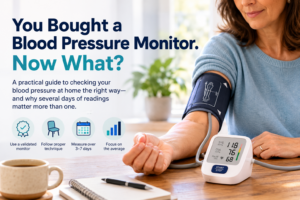
Many people leave their doctor’s office with one simple instruction:
“Check your blood pressure at home.”
It sounds straightforward, but that simple advice leaves many unanswered questions.
When should I check it? How often? Should I take one reading or two? Does it matter if I just walked upstairs? What if I’m nervous?
The answers matter because checking your blood pressure incorrectly can lead to inaccurate readings, making it harder for you and your healthcare team to know whether your blood pressure is truly controlled.
Unfortunately, this is common. In our research, we found that many patients were not measuring their blood pressure at home according to guideline recommendations. Common issues included inadequate rest before measuring, incorrect positioning, inconsistent measurement schedules, and relying on too few readings. (PubMed)
The good news is that measuring your blood pressure correctly is straightforward once you know the proper technique.
Key takeaway
Your healthcare provider is usually not interested in one isolated blood pressure reading. They are interested in your average blood pressure measured correctly over several days.
Step 1: Choose a validated blood pressure monitor
Not all blood pressure monitors are equally accurate.
Choose a validated upper arm blood pressure monitor whenever possible. Upper arm cuff devices are generally preferred for home blood pressure measurement. A helpful resource is ValidateBP.org, which lists devices that have been tested and validated for clinical accuracy. (Validate BP)
If an upper arm cuff does not fit properly because of arm size or another limitation, a validated wrist monitor may be an alternative. However, wrist monitors are more sensitive to positioning. If you use one, carefully follow the manufacturer’s instructions and keep your wrist at the level of your heart during the measurement.
Step 2: Prepare before measuring
Before checking your blood pressure:
- Avoid caffeine, smoking, and exercise for at least 30 minutes.
- Empty your bladder if needed.
- Sit quietly for at least 5 minutes.
- Sit in a chair with your back supported.
- Keep both feet flat on the floor.
- Rest your arm on a table so the cuff is at heart level.
- Avoid talking during the measurement.
These simple steps help reduce temporary factors that can affect your blood pressure. (American Medical Association)
Step 3: Measure correctly
When checking your blood pressure:
- Measure in a quiet environment.
- Take two readings, about one minute apart.
- Record both readings.
- Do not worry if the first reading is slightly higher than the second. This is common.
The American Heart Association recommends taking two readings one minute apart when monitoring blood pressure at home. (www.heart.org)
Step 4: One reading is not enough
One of the biggest misconceptions about home blood pressure monitoring is that a single reading tells you whether your blood pressure is controlled.
Blood pressure naturally changes throughout the day because of physical activity, stress, anxiety, meals, sleep, medications, and normal biological variation.
For this reason, healthcare providers generally do not make treatment decisions based on one isolated reading.
Instead, current guidelines support a structured approach to home blood pressure monitoring. This usually means measuring blood pressure over several days, using the same technique each time. The 2025 U.S. high blood pressure guideline supports home blood pressure monitoring as part of diagnosis and management, and prior evidence supports duplicate morning and evening readings over 7 days, or at least 3 days when 7 days is not feasible. (American Heart Association Journals)
A structured home blood pressure assessment typically includes:
- Measuring blood pressure in the morning and evening.
- Taking two readings each time.
- Completing measurements over 3 to 7 days.
- Calculating the average of the readings.
This provides a much more reliable estimate of your usual blood pressure than any single measurement.
Importantly, many blood pressure targets used to diagnose and treat hypertension were developed using standardized measurement protocols rather than occasional spot checks. Following a similar structured approach at home gives your healthcare provider information that is more useful for clinical decision-making.
Step 5: How often should you check your blood pressure?
Home blood pressure monitoring does not usually mean checking your blood pressure every day forever.
Instead, think of it as completing an assessment whenever your healthcare provider needs updated information.
Common times to complete a structured home blood pressure assessment include:
- When you are first diagnosed with high blood pressure.
- Before an upcoming healthcare appointment.
- After starting or changing blood pressure medication.
- If your blood pressure appears to be changing.
- Whenever your healthcare provider asks for updated readings.
If your blood pressure has remained well controlled and your medications are stable, your healthcare provider may recommend repeating a structured assessment every 1 to 2 months, or on another schedule that fits your care plan.
Step 6: Focus on the average
Your healthcare provider is usually much more interested in your average blood pressure over several days than in your single highest or lowest reading.
Averages reduce the effects of normal day-to-day variation and provide a clearer picture of your usual blood pressure.
The bottom line
Home blood pressure monitoring is one of the most valuable tools available for managing hypertension, but only when it is performed correctly.
Buying a blood pressure monitor is only the first step.
Using a validated device, following proper measurement technique, and completing a structured assessment over several days will provide information that is far more useful than occasional spot checks. It can help your healthcare team make better treatment decisions.
Looking for an easier way?
BPCorrect guides patients through a structured home blood pressure assessment based on current hypertension guidelines. It helps you measure blood pressure correctly, organize your readings, and generate meaningful averages that are easy to share with your healthcare team.
About the author
Cara Litvin, MD, is a primary care physician, clinical informaticist, and researcher whose work has focused on improving the quality of home blood pressure monitoring and helping patients and clinicians use structured home blood pressure assessment to make better treatment decisions.
References
- 2025 AHA/ACC/AANP/AAPA/ABC/ACCP/ACPM/AGS/AMA/ASPC/NMA/PCNA/SGIM Guideline for the Prevention, Detection, Evaluation, and Management of High Blood Pressure in Adults. (American Heart Association Journals)
- American Heart Association. Home Blood Pressure Monitoring. (www.heart.org)
- ValidateBP.org. Validated blood pressure device listing. (Validate BP)
- Behnke CN, Litvin CB. Exploration of Patients’ Practices Related to Home Blood Pressure Monitoring. (PubMed)